Should You Look at Houses Over Your Budget?
Almost every single person, couple, family or investor deliberately looks at houses over their budget when searching for something to buy.
They might justify it in different ways, but curiosity always ends up winning.
It feels harmless at the time, though studies show that how this simple act of curiosity can have far greater and long term effects.
What is actually happening when buyers look at houses over their budget is that their expectations start to shift without them realising.
Why Looking at Houses Over Your Budget Feels Like a Good Idea
On the surface, it makes sense and people can easily justify it to themselves:
- You want to understand what’s possible
- You want to feel confident you’re not missing out, just in case the owners will accept an offer significantly below the price guide
- Sometimes it even feels motivating (like aiming higher might push you to make a better decision)
The problem is, property doesn’t work like that.
Unlike most purchases, property is highly emotional and you’re anchoring your expectations to a price point, not looking at the reality of a spreadsheet.
Psychologists call this anchoring bias, where the first number you see influences how you judge everything that follows. Once that anchor shifts, it’s very hard to bring it back.
What Actually Happens When You Start Looking Above Your Budget
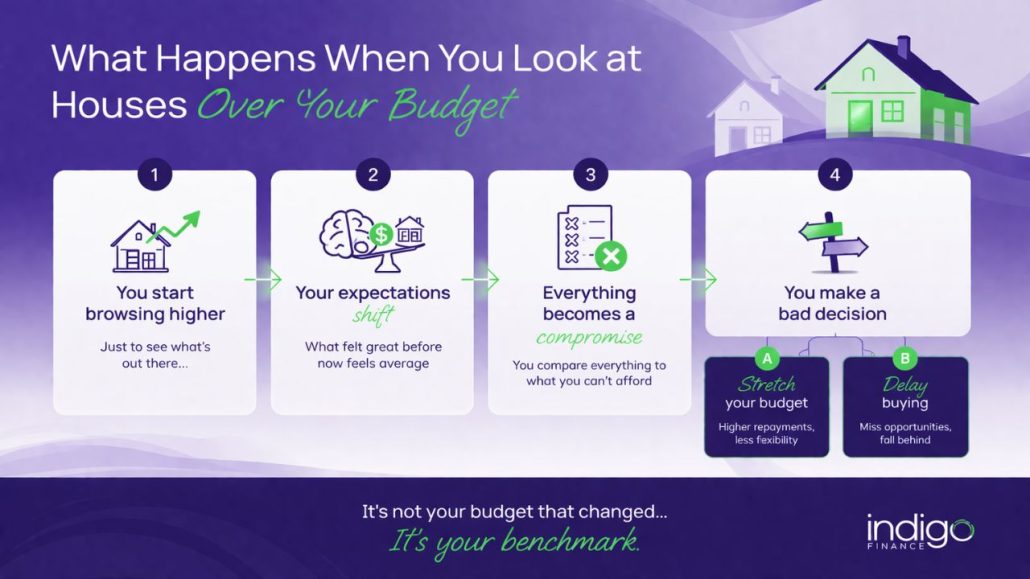
This is where things change, usually without you noticing. You start comparing every property to something you can’t realistically buy. A home that would have felt like a great fit a week ago now feels like a compromise.
After seeing your “dream home” several hundred thousand dollars over your budget, you now walk through inspections thinking, “Yeah… but it’s not quite like that other one.”
And you’re right. It’s not. But it might also be several hundred thousand dollars less. That’s compromise.
Unfortunately, what then happens is that your definition of what feels “right” starts creeping higher and higher. And worse still, out of your reach.
Unintended Consequences
This is where one of two things usually happens:
- You either stretch your budget to chase that feeling
- Or you hold off completely, waiting for something that doesn’t quite exist at your price point
If you go down path #2, which people often do, then what happens in that time is that prices don’t generally come down and bring “unrealistic” back into your budget. They do exactly the opposite. Prices generally continue to rise, just as they have done for decades, and what you would have been happy with initially now also stretches out of range.
Once this happens, all of a sudden buyer’s feel like they are on the back foot, backed into a corner. That then translates to making forced, hasty decisions just to get the entire process over with.
At best, they buy something that isn’t quite right, however at worst, they end up overpaying for something they really didn’t want.
A Simple Example Most Buyers Don’t Notice
Let’s say your budget is around $1,000,000.
And let’s assume that price point gets you a solid home where you are searching in Australia. Good location, liveable, and maybe just a few compromises. Overall however, it’s a smart buy and solid long term investment.
Then you start looking at properties around $1,100,000 to $1,200,000.
Suddenly, you’re seeing:
- Better layouts
- Nicer finishes
- More space
- Better streets
Now when you go back to looking at $1,000,000 homes, they feel… underwhelming. Not because they’re bad, but because your benchmark has shifted.
You also get the feeling that you deserve the nicer house and in some way, looking at the $1,000,000 home makes you look “poor”.
In sales, it’s commonly referred to as the contrast effect. Science might refer to it as hedonic adaptation
The Real Cost of Buying a House Over Your Budget
Let’s be honest. Property is an emotional decision. Even the most seasoned investors with a spreadsheet in front of them can be turned off a property because of the kitchen tiles, or street aspect. So when it comes to home buying, emotions can run high.
With regards to budget, all of a sudden after looking at properties you can’t afford, people start thinking:
“It’s not that much more…”
or
“We’ll make it work…”
And to be fair, sometimes you can.
But stretching your budget doesn’t just affect the purchase price. It changes:
- Your monthly repayments
- Your ability to save or invest
- Your flexibility if interest rates change
- Your options for your next move
In other words, it can quietly slow down everything that comes after this purchase. However, in the cloud of emotion of the moment, people often dismiss what long term ramifications might have been caused.
The alternative isn’t much better either. If you pull back completely and end up delaying the purchase for months (or even years), it’s easy to end up chasing something that was never realistic at the price point.
How to Look at Property the Right Way
This is going to sound very simple, but in reality is quite hard.
If you want to know exactly what you can spend, speak with an expert lending adviser before you begin your search. Base your search on the reality of the numbers and not some emotional figure that doesn’t exist.
You also have to understand all your expenses in buying the property, so that you can factor in everything from day one. These include (but are not limited to):
- Stamp duty (approx. $68,000 in NSW for a $1.5m property although varies by state)
- Valuation and inspections ($1,500 – $2,000 per property)
- Legal and conveyancing fees ($1,500 – $3,000)
- Moving costs
Then, when you are ready to search:
Start by looking at what properties have SOLD in your area within the last 6 months that are within your budget. On RealEstate.com.au and Domain.com.au, you can filter searches for sold properties by price.
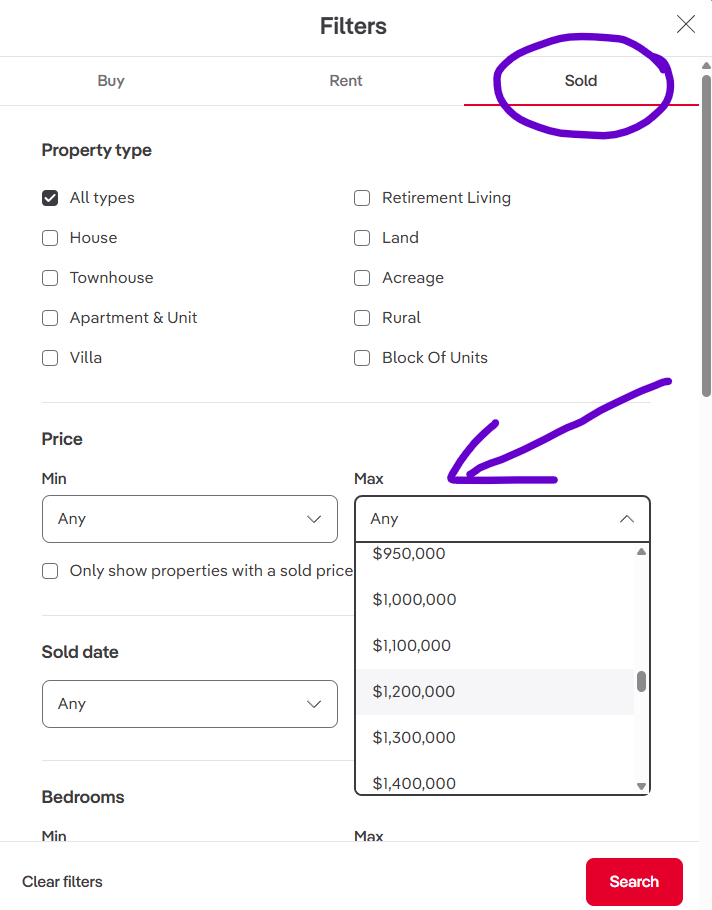
The biggest mistake people make is that they listen to agent “price guides” for properties for sale. Unfortunately, they mean almost nothing. The reality is what people actually pay for a property. That’s what they’re actually worth.
If a property you are looking to buy is not within your budget in that sold section, then you need to change your expectations. Fast.
Next, when it comes time to search, you should have a better idea of what a property is actually selling for. So start looking for a house comfortably within your true buying range and not your absolute maximum.
Track what agents are quoting and what the properties are selling for. Keep a spreadsheet of your search. Most people can’t remember all the properties they inspect, let alone specific details of each.
Once you have a handle on the local market well within your budget (and you haven’t yet found your dream home), then you can expand your search to look toward the top of the range (and even slightly above it if you keep it tight).
Spend most of your time reviewing properties you can actually buy to keep your expectations grounded and focus on what matters long term. Location, layout, and future potential matters more than cosmetic upgrades. Don’t lose sight of the bigger picture.
Just remember, your goal isn’t to buy the most impressive property you see, it’s to buy something that works for you now, and still puts you in a strong position later.
Where a Lending Adviser Actually Helps
This is the part most people get wrong, because a lending adviser’s (or broker’s) role isn’t just to tell you how much you can borrow, it’s to help you understand what you should borrow based on your situation, goals, and future plans.
That includes things like:
- Structuring your loan so you’re not overcommitted
- Understanding how different lenders assess your situation
- Making sure this purchase doesn’t limit your next one
With our clients, a big part of the conversation is about making sure the decision you’re making today still makes sense in a few years’ time.
Be Aware of Psychology
If you understand what is actually going on, you’ll always be in a far better position to buy.
Looking at houses over your budget doesn’t motivate you, it just changes what “good” looks like, and that can be a very dangerous thing.
You want to be able to make a clear, confident decision and clouding your judgement makes that almost impossible.
The buyers who move forward successfully are the ones who stay anchored to what they can afford, and make smart decisions from there.
Common Questions About Looking at Houses Over Your Budget
Should I look at houses over my budget?
It’s fine to look slightly above your budget to understand what’s available in the market, but consistently looking too far above your range can shift your expectations and make realistic options feel disappointing.
It’s more important to track agent price guides and actual sales figures so you understand what market expectations are.
How far over budget should I look at properties?
Once you have looked at properties well within your budget, considering properties 5 above your budget is enough to give context without distorting expectations.
What should I do if I can’t afford the house I want?
You can either adjust your expectations, change your strategy, or speak with a broker to understand your real options.
Why do cheaper houses feel worse after viewing expensive ones?
Cheaper houses feel worse because your benchmark has shifted. What once felt right now feels like a compromise even when it isn’t.