

Buyer Fatigue Is Real – Here’s How to Beat It
Property searching sounds exciting at the start. Weekends at open homes, scrolling through listings, imagining life in a new place. But somewhere along the way, for most buyers, it stops feeling exciting and starts feeling exhausting. That’s buyer fatigue. And right now, in mid-2026, it’s one of the most common reasons good buyers are missing good opportunities.
Why searching feels harder than it used to
It’s no secret that the Australian property market has become a more complex place to navigate. The Westpac–Melbourne Institute “time to buy a dwelling” index hit a cycle low of 72.0 in May 2026, nearly 50 points below its long-run average of 119. June saw a partial recovery to 81.1, but sentiment remains well below historical norms, with the squeeze between housing demand and affordability still front of mind for most buyers.
Add to that the sheer volume of properties buyers feel they need to inspect, compare, and second-guess, and it’s easy to see why so many people feel stuck.
But here’s the thing – the market being harder to read doesn’t mean good opportunities aren’t out there. Rising stock levels are actually increasing buyer choice and negotiating power in some cities right now. The conditions that feel daunting are, for a prepared buyer, genuinely worth stepping into.
What buyer fatigue actually looks like
Buyer fatigue doesn’t always feel like exhaustion. Sometimes it looks like:
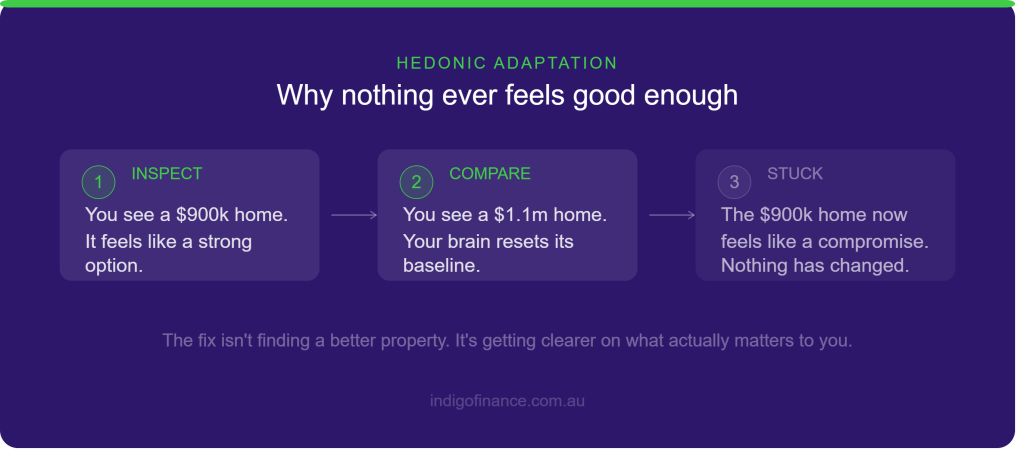
Constantly shifting goalposts. You inspected a home three months ago that felt like a strong option. You passed. Now it looks great in hindsight, and it’s either gone or has gone up in price. Psychologists call this hedonic adaptation: once you see something better, your brain resets that as the new baseline. So everything within your actual budget starts to feel like a compromise, even when it isn’t.
The “wait and see” trap. Waiting feels patient and disciplined. But there’s a cost that isn’t always obvious. Rate cuts are providing limited momentum as affordability constraints and economic uncertainty continue to weigh on activity, meaning the buyers who are ready to move when the right property appears are the ones who will benefit most from any shift in conditions.
Decision fatigue from too many options. The more properties you inspect without a clear framework for what matters, the harder each decision becomes. You’re not being indecisive; you’re operating without a clear enough filter.
The myth that’s keeping buyers stuck
Most buyers start their search with a list of everything they want, a budget they’re flexible about “for the right place,” and a quiet belief that the right home will just feel right – instantly, without hesitation, without competition.
That version of buying a home almost never happens.
Every property involves trade-offs. A great location often means less space. More space often means an older finish. A fully renovated home almost always commands a premium. You can improve one area, but it rarely comes without a cost somewhere else.
This isn’t a reason to settle. It’s a reason to get clearer about what actually matters to you, because once you do, the search gets a lot easier.
What the current market actually means for buyers
After an extended period of strong growth, Australia’s housing markets are moving into a new phase. Sydney and Melbourne are recording price corrections, while Perth continues to power ahead, reinforcing just how uneven the national market has become.
For buyers, a period of recalibration is not a bad thing. The fundamentals supporting housing over the longer term remain intact: continued population growth, a chronic shortage of skilled construction labour keeping new supply constrained, and an RBA that is widely expected to be nearing the end of its current tightening cycle.
In other words, waiting for a “better time” carries its own risks. The buyers who move forward with clarity tend to do so not because the market is perfect — it never is — but because they’ve decided they’re ready.
How to break out of buyer fatigue
Get genuinely clear on your priorities, not your wish list. There’s a difference between what you want and what you need. Write down your non-negotiables (the things you genuinely won’t compromise on) and your nice-to-haves (the things you’d love but could live without). Most buyers find this list is much shorter than they expected.
Understand your borrowing capacity with certainty. Banks are reassessing borrowing limits more frequently in the current environment, so a pre-approval that’s a few months old may not reflect what you can actually borrow today. Get that clarity before you inspect another property.
Set a realistic price benchmark. Look at what has actually sold in your target area within your budget in the last three to six months, not what’s listed, what’s sold. That’s your real market, and measuring properties against it will save you enormous mental energy.
Give yourself a decision framework. When you inspect a property, ask: Does it fit my budget without stretching too far? Does it meet my key needs? Are there any major issues that would cause real problems later? Does it still make sense in five years? If the answer to those questions is yes, you’re not settling, you’re making a considered decision.
Limit how long you keep looking. There’s a point in most searches where more inspections create more confusion, not more clarity. If you’ve been searching for six months or more, it may be worth asking whether the bar has moved — and if so, why.
The property doesn’t need to be perfect to be right for you
A home doesn’t need to tick every box to be a genuinely good decision. The buyers who move forward successfully aren’t the ones who found the perfect property, they’re the ones who found a property that worked well for their situation and had the confidence to act on it.
The right home isn’t something you find fully formed. It’s something you make your own.
If you’re experiencing buyer fatigue, that’s a normal and very human response to a complex process. The answer isn’t to keep searching harder – it’s to search smarter, with a clearer sense of what you’re actually looking for.
The search feels hard right now for a lot of buyers. But hard and impossible are very different things. Get clear on what matters, make sure your finances are in order, and measure properties against your own criteria, not against the best thing you’ve ever seen. That’s how good buyers move forward.
