

Should I Get A Fixed Rate Loan Before 2026?
The Australian lending landscape is shifting as we head into 2026. With recent lender moves on fixed rate pricing, many borrowers, investors, first-home buyers and brokers are asking a key question: “Should you lock in a fixed rate loan before 2026?”
Over recent months, several lenders have moved fixed interest rates higher. At the same time, major banks and economists are signaling that the interest rate cutting cycle may be over, at least for now. While no one can predict interest rates with certainty, the environment has clearly shifted.
Following on from the Reserve Bank of Australia’s (RBA) move to hold interest rates in December, both the Commonwealth Bank of Australia (CBA) and National Australia Bank (NAB) have revised their cash rate forecasts. They are now suggesting that an increase is likely in February, meaning there could be uncertain times ahead for borrowers.
However Westpac and ANZ are still suggesting a rate hold is most likely, thus showing all of us that even the best economists in the country can’t agree.
So let’s break down the latest developments, explain what they mean for you, and explore the pros and cons of locking in a fixed rate loan before 2026.
Why Fixed Rates Have Started Moving
Lenders set fixed rates based on expectations about future interest rates, funding costs, and economic conditions, not just the current RBA cash rate.
Recently:
- Major banks have revised their outlooks and no longer expect further interest rate cuts in the near term
- Inflation remains higher than the RBA would like
- Funding costs for banks have increased compared with earlier in the year
As a result, some lenders have already increased fixed rates, particularly for one to three year terms. This does not mean all fixed rates are high, but it does suggest the lowest fixed rate window may be closing.
What the Interest Rate Outlook Looks Like
While the RBA has held the cash rate steady, market expectations now point to a prolonged pause rather than further cuts. Some economists are even warning that if inflation remains sticky, the next move could be upward rather than downward.
For borrowers, this creates a different decision environment:
- The chance of meaningful rate cuts before 2026 appears limited
- The risk of rates staying higher for longer has increased
- Certainty is becoming more valuable than speculation
This is why many borrowers are revisiting fixed rate options now rather than waiting and it’s also why we’re suggesting that all clients take a look at their current position.
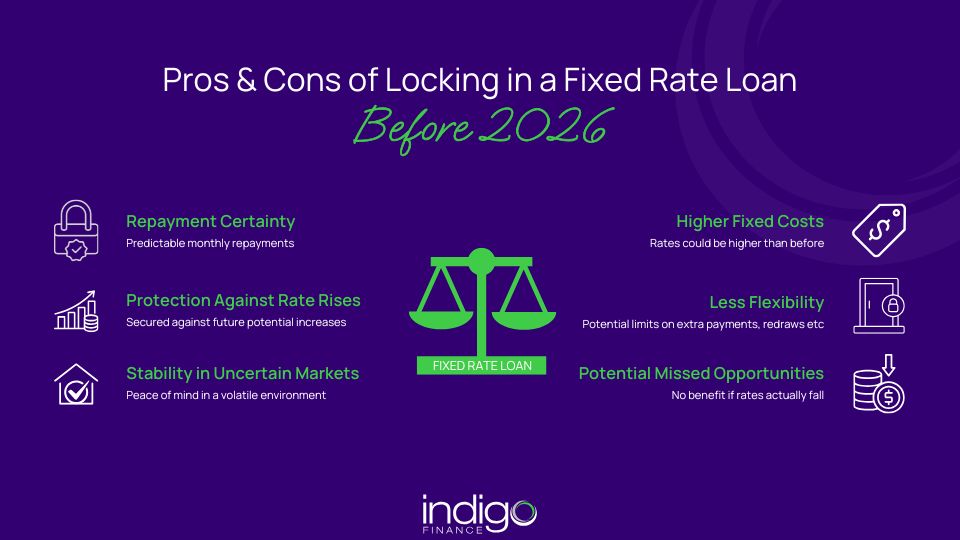
Pros and Cons of a Fixed Rate Loan before 2026
Here is a clear comparison to help you decide whether locking in a fixed rate makes sense now.
Pros of Locking in a Fixed Rate
1. Repayment Certainty
A fixed rate loan before 2026 gives certainty over your principal and interest repayments for the fixed period. This helps budgeting and cash flow planning.
2. Protection Against Future Rate Rises
If official interest rates increase in 2026, a fixed rate protects you from those rises for the term you choose.
3. Stability in a Changing Market
With regulatory changes and lending conditions evolving, fixing a rate now may offer peace of mind, even if markets remain uncertain.
Cons of Locking in a Fixed Rate
1. Higher Fixed Pricing in Some Cases
Some lenders have already moved fixed rates higher compared with earlier in the year. Locking in now could mean paying more than if rates soften later.
2. Less Flexibility
Most fixed rate loans come with restrictions on extra repayments, redraws or early exit fees. If your circumstances change, you could incur costs.
3. Opportunity Cost if Rates Do Fall
If official rates are cut unexpectedly or competition pushes variable rates down, fixed rate holders could miss out on cheaper repayments.
Different Considerations for Home Owners and Investors
For Home Owners
If certainty and peace of mind are important, fixing part or all of your loan before 2026 may make sense. This is particularly relevant if your budget would be strained by higher repayments. It’s a way to “hedge your bets” without knowledge or expertise to predict what interest rates may do.
For Investors
Investors often benefit from flexibility. Some choose a split loan structure, fixing part of the loan for stability while keeping part variable to maintain flexibility and access to equity. You need to consider your ability to refinance or extract more equity in the future.
Is a Split Loan Sensible?
A split loan (which combines fixed and variable portions) could be sensible common ground for many. It reduces exposure if there are rising interest rates, allows you to maintain flexibility for extra repayments or refinancing and balances certainty with opportunity.
For many borrowers, it’s a practical compromise rather than an “all-or-nothing” decision.
Key Considerations Before Deciding
Before you make any decision on the future of your loans, it’s strongly recommended to sit down with a lending adviser. A lending adviser can work through strategy that’s more important than the headline interest rates. Here are some practical factors you and your lending adviser should weigh up:
Your Financial Situation
If you value certainty and are managing a tight budget, locking in a fixed rate may be more appealing. An easy check is to analyse whether your budget is sensitive (and if so how sensitive) to rate rises.
Loan Purpose
If you are an investor, the fixed rate decision can affect cash flow and investment return assumptions. For owner-occupiers, certainty can be a priority. You also need to consider how long you intend to hold the property for.
Market Expectations
While rate cuts seem unlikely soon, market prices can shift, particularly if inflation surprises to the downside.
Your Future Plans
Do you have immediate plans to move, sell, invest, or refinance? If so, all of these variables need to be considered as they can have significant impact. Don’t overlook details that will have a big impact in the future. The key is to make decisions based on your own goals, not headlines.
Where to From Here?
Deciding whether to lock in a fixed rate loan before 2026 depends on your personal goals, risk tolerance and the wider market environment.
Locking in can be a smart move if you want certainty and protection against rate rises. Staying variable may work better if you are comfortable with flexibility and expect stronger competition or rate falls that could benefit variable pricing.
It may also be worthwhile to consider a split loan, combining fixed and variable components to balance security and flexibility.
Everyone is different. Every circumstance is different. There’s no “one size fits all” approach to mortgages. That’s why it’s essential to have your options laid out for you in plain English.
The important thing that applies to everyone though is that today is an ideal time to sit down with a lending adviser and plan how you are going to approach 2026. Don’t wait until after Christmas. Get your finances sorted asap. If that’s with us, we’d love to chat. Reach out and we’ll take a look at your loans today.

